
It's been so long since I wrote anything that I feel like I've forgotten how to type. I'm now in the Gulf of Siam, 55 km from the Thai coast, sailing on a ferry toward the city of Surat Thani. A little about what's happened over the last three weeks while I've been out of touch.
Table of contents:
Cambodia
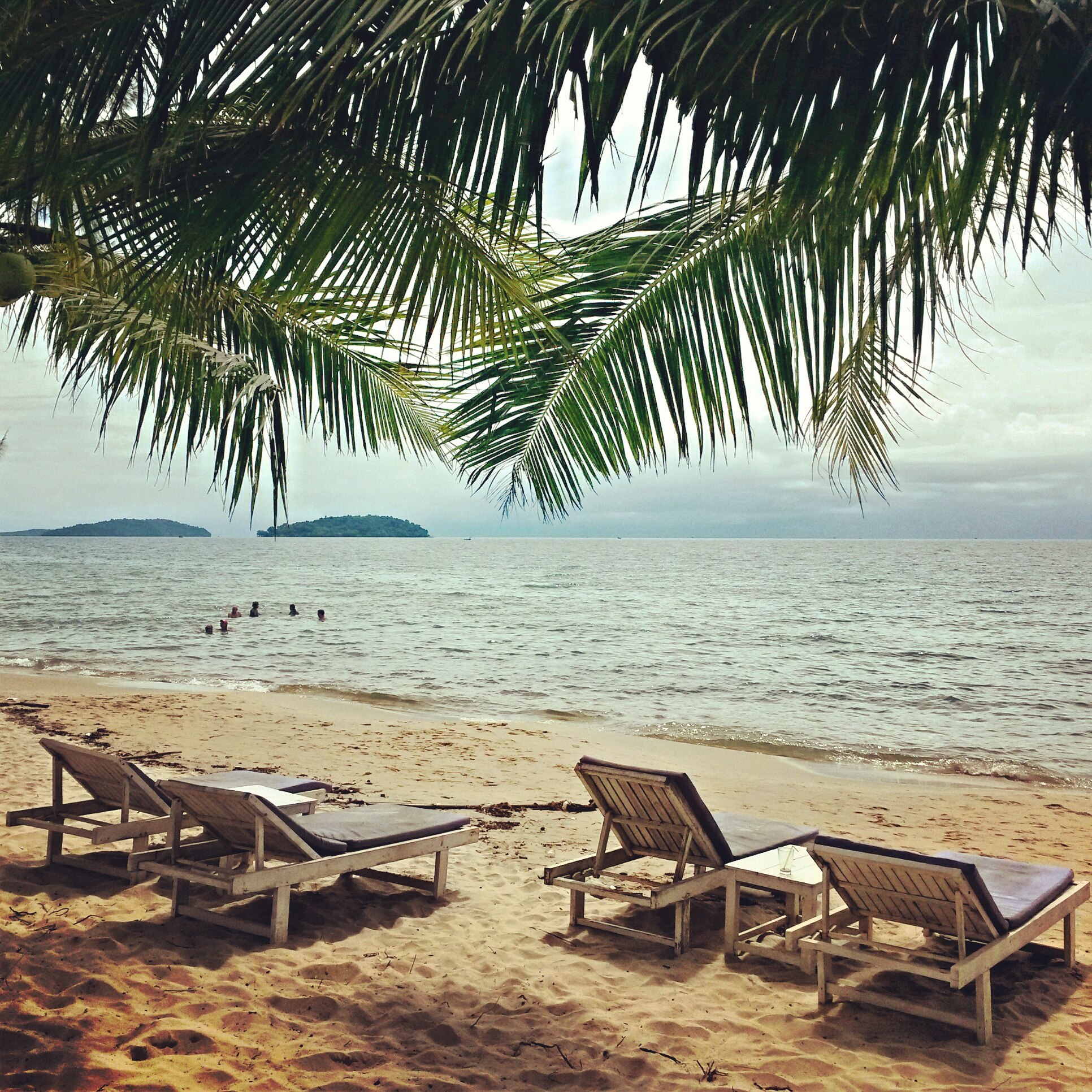
While waiting to meet Inessa, who was supposed to fly into Bangkok on November 16, I spent about two weeks in the south of Cambodia. During that time I had a great rest on the coast, did some surfing, rode my new bike to neighboring provinces where I met old acquaintances, partied at various events, joined the local Russian diaspora, and met a whole bunch of strange people.
For example, 29-year-old Denis had just been released from a Thai prison, where he spent 4 months for drug dealing in Pattaya. He was turned in to the police by the local drug dealers for undercutting the illegal goods. When Denis was arrested, his mobile phone was confiscated. The police were ready to turn a blind eye to the crime for a symbolic 5000 baht (10000 rubles at the current rate). Denis didn't have any cash on him, and he wasn't given the chance to call his friends. That's how he ended up in a pre-trial detention cell, from where he was brought to court a few days later. In a Thai court you're not provided a lawyer. Not only a lawyer, but even an interpreter. So all Denis could understand during his sentencing was — 2 years. In a way, he was lucky, because under Thai law the distribution of hard drugs is punishable by the death penalty or life imprisonment. In the same cell as Denis there were 250 people. They slept lying on their sides, because the size of the cell didn't allow everyone to lie on their backs. About half of the cellmates are Europeans. They cluster in groups of 10-15 people by nationality. Besides Denis, there were 10 more Russian guys in the cell. Most ended up there for drugs. But not all. One Russian was working unofficially as a guide at the Pegas tourist agency in Pattaya. Once 30000 baht went missing from the company's office, this Russian guy was accused of the theft, a report was filed with the police, and he went to prison. According to him, he's not guilty, he was just made the scapegoat. Later it would turn out that a mistake had been made and the real fraudster was identified. Pegas sent an official request to the police with apologies for the situation, but under Thai law, once a person is convicted, they must serve their sentence to the end. This guy has no parents or close friends who could buy him out of prison. Some cellmates sympathize with his situation and chip in whatever they can toward his return ticket to Russia. That way he's already saved up almost 11 thousand baht.
Let's get back to Denis. Some time after Denis stopped getting in touch, his parents in Moscow filed an international missing-person report on him. And FOUR months later they found him in a Bangkok prison. They had to fly to Thailand in person to put down a deposit for his early release, timed to an amnesty of certain foreigners by decree of the King of Thailand. The ransom sum came to 2000 US dollars. Denis wasn't handed over to his parents; instead he was deported back to Russia at the state's expense. At Domodedovo airport, at passport control, he showed some quick thinking and lied that he'd been convicted for maliciously violating the visa regime. Nobody asked him any more unnecessary questions. That's how he got his foreign passport back right at the airport and flew to Asia again a month later. The road to Thailand is closed for him, so now he lives in Cambodia and, probably, goes about the same business. Another man, whose name I don't remember, is hiding from the Russian mafia. He was the "overseer" of either Irkutsk or Izhevsk. He got mixed up in some murky affair and a hit was ordered on him. So he lay low in Cambodia. A third guy, Sasha, doesn't remember how he got to Thailand. The last thing he remembers is that in Moscow he took some hard drug with friends and went to a club. He woke up in a hospital with a cracked skull. Then again he remembers nothing. The next time he woke up in Bangkok. Finishing the stories about the "bad boys", I'll tell you about yet another Russian "bad boy", Felix. Here's how my acquaintance, the traveler Diana Rusanova, who recently visited him in a Bangkok prison, describes Felix's story:
"Felix Cheremnykh has been sitting in Thailand for 12 years already. Most of that time — in the Bangkok prison Bang Kwang, also known as the Bangkok Hilton. Felix and his two buddies once planned to rob a Thai bank, and in the process, carelessly and by accident, killed a policeman. The unhurried Thais caught up with them when they, on a yacht bought in advance, were already approaching the shores of Cambodia. For varying degrees of guilt, the generous Thai court (truly generous, since farangs had never before received such punishments) sentenced them to the death penalty, one life sentence, and one 34-year imprisonment. As a result of a series of royal pardons on holidays, someone has already been released, while someone still has just a little time left."
This Felix is an interesting character. If anyone's interested, read the full version of the interview with him — http://www.free-writer.ru/pages/bangkokhilton.html All these stories, based on real events, reminded me of the plot of Gregory David Roberts' book — "Shantaram". Of course, I met other people too. For example, my neighbor Martin, a musician from God who moved from Germany to live and work in Cambodia. By the way, his job is a rehabilitation program for released prisoners. Various psychological work on the socialization of former inmates. So all the Cambodian stories this time, one way or another, echoed the theme of crime, prisons, bad boys, and drugs. After two weeks of living on the coast of the Gulf of Siam, I felt uneasy about where my life was turning, and I hurried to leave one of my favorite countries and set off further overland into Thailand.
The last stretch of the route into Thailand overland
To the border with Thailand near the city of Koh Kong from Sihanoukville, where I spent the last couple of weeks, it's only 300 kilometers. I'm riding in a comfortable minivan with air conditioning and wi-fi. At the border with Thailand I have to transfer to another bus, since in Thailand, unlike Cambodia, traffic is on the left. Besides me, the bus carries a few more backpackers, a couple of Russians, and a couple of Ukrainians. The stretch of the route through Thailand from the border to Bangkok — the virtual final destination of the route — is only about 450 kilometers. The whole journey takes 12 hours as planned. I crossed the border quickly and without any difficulty. Contrary to Thailand's new visa legislation, I received the standard stamp for visa-free entry into the Land of Smiles for 30 days (under the new rules from May 2014, when crossing the land border with Thailand, Russian citizens are supposed to get a stamp for 15 days). Transport at the border is practically nonexistent, and I had difficulty finding the stop where the next bus was supposed to pick me up. After waiting for it for about an hour in the scorching heat, I picked a comfortable seat on the bus and got ready to be in Bangkok by dinnertime. But it wasn't to be. Half an hour into the journey, at a gas station not far from the border town of Trat on the Thai side, the driver asks us to transfer to another bus with our belongings. Instead of a bus, a songthaew pickup truck pulls up, in the back of which we ride the next 20 kilometers to the bus station. We get dropped off again. The pickup driver heads to the ticket office and buys tickets for all the van's passengers for a scheduled bus to Pattaya.
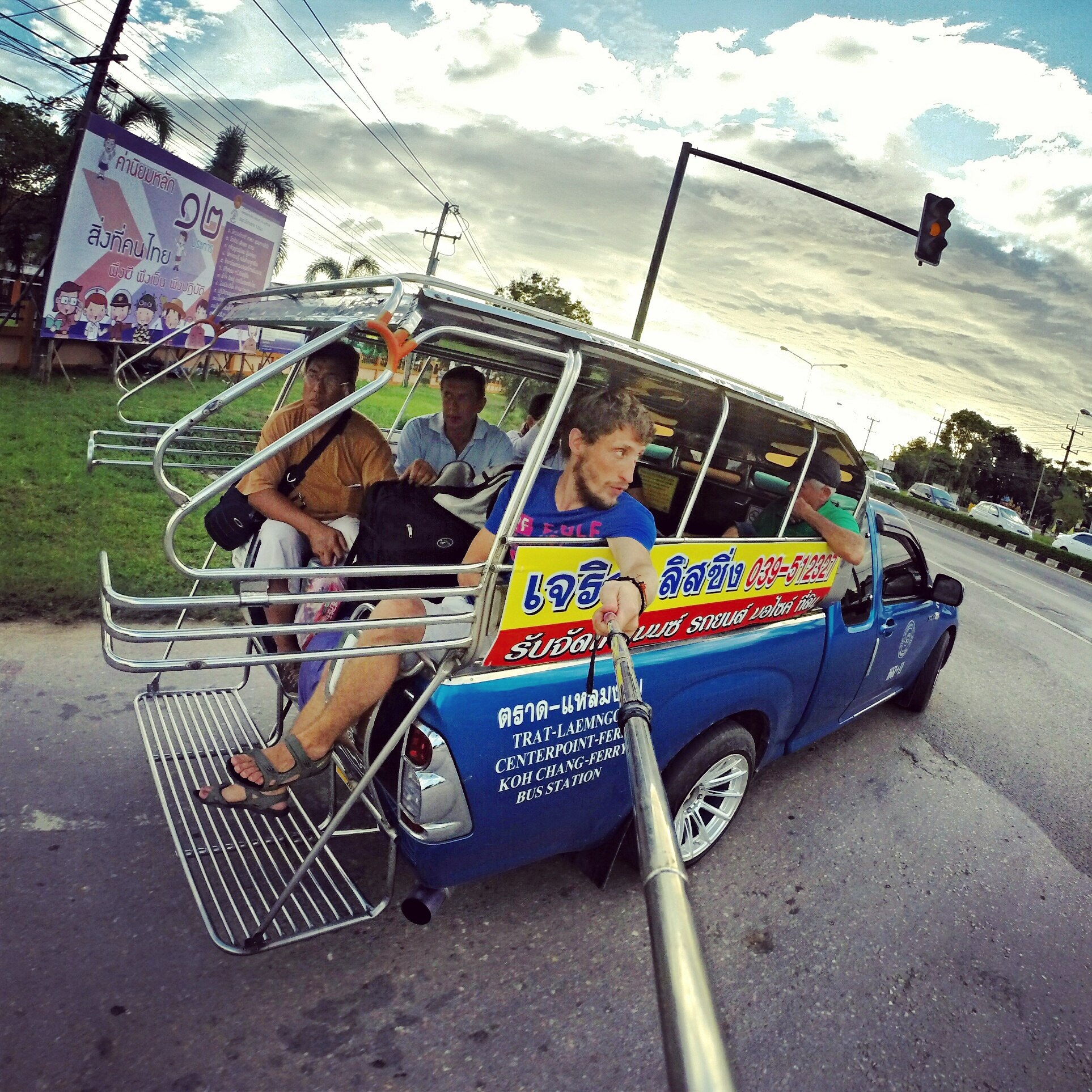
According to the schedule, about an hour remains until the bus departs. The passengers are bewildered and heap all sorts of curses on the tour-operator company that sold them the tickets for this trip. As it later turned out, each of them had bought their ticket at a different price and for a different class of travel, from the cheapest to VIP class. If I paid about $25 for my ticket, then for some fellow travelers this leg cost almost twice as much. The scheduled bus took me to the final station — the Pattaya bus terminal, where another minivan to Bangkok was already waiting. In total I switched between 6 types of transport on the final stretch Sihanoukville — Bangkok and spent about 17 hours on the road. Exhausted by the hard journey, my fellow travelers became very talkative and friendly toward the end. No wonder — over this trip we'd practically become like family. We helped each other unload and load luggage at the numerous transfers, had breakfast, lunch, and dinner together, and shared impressions of traveling through overseas countries. Many of them admitted that this was the hardest road they'd ever overcome before. To warn readers who are planning to get from Cambodia to Thailand overland, I'll mention the name of the agency that sold me the tickets for this exhausting trip, which promised an easy 12 hours on two comfortable buses — Mottah travel. In Sihanoukville it's a fairly popular agency. There are advertising banners around the city promoting the company's services, so there's a good chance you'll buy your ticket from them, which I certainly don't advise.
Bangkok
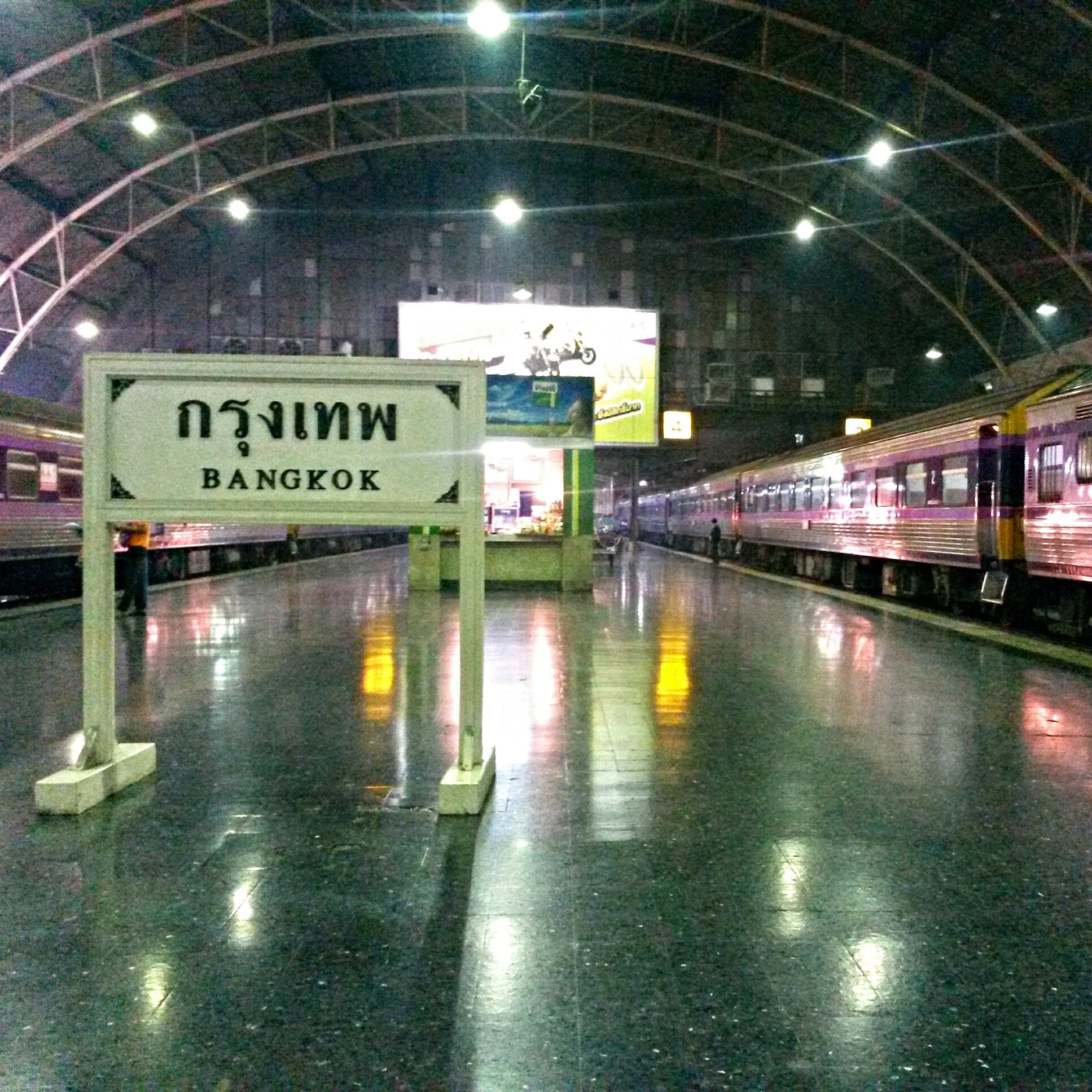
I've been to Bangkok several times before, I like it here and I know the city quite well. The other day Inessa finally joined the trip. We spent a few days in the concrete jungle walking around the city's tourist sights, strolling through parks, the famous red-light districts, rafting along the canals, and then we set off to the south of the country by train. On one of the red-light streets I accidentally ran into Claudio, an Italian acquaintance of mine with whom we traveled through China a couple of months ago. It's a very strange and pleasant feeling — accidentally meeting your acquaintances in different corners of the planet.
Thai trains
They're always late. Second class is the equivalent of our platskart (third-class open-plan sleeper). The only difference being that along both sides of the carriage there are "side berths". There are air conditioners, fans, and curtains to close yourself off from fellow passengers during sleep.
The conductors help transform the seats with little tables into beds for the night and make the bedding very skillfully. The sleeping berths are more comfortable and wider than in Russian trains. Tickets for the lower berth cost a bit more than for the upper one, since in width it's like a one-and-a-half bed, and if desired two slight people can fit on it.
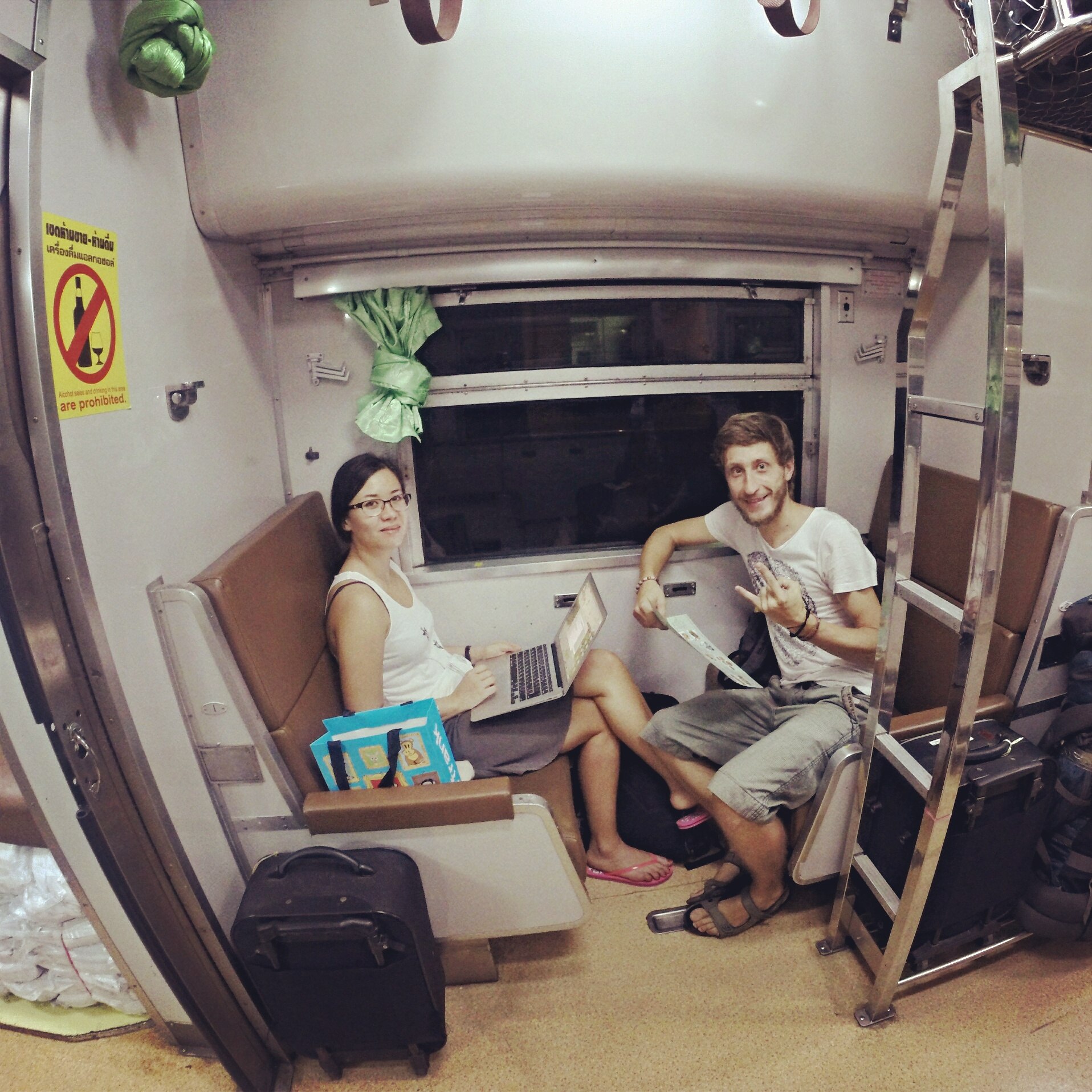
Drinking alcohol and smoking are prohibited on the trains. The dining carriages offer decent breakfasts and dinners with delivery to your compartment. In the dining carriage the windows are wide open. At speed, the warm wind blows right through the carriage. Even so, it's still smoky and noisy here. The patrons are mostly foreigners. Prices are 30-50% higher than in ordinary cafes and restaurants, but still acceptable. The food is tasty. The road from Bangkok to the capital of Surat Thani province — the city of Surat Thani — took all night. From the train straight to the bus, and from the bus to the ferry to the islands of Samui and Phangan, where the next month and a half of my life in Thailand passed.