
I am now in my third month of living in the Land of Smiles. And all this time the Russian currency has kept plunging. Many tourists are abandoning their earlier plans, postponing their vacations, and returning their travel vouchers. The trend of recent years is wintering in warm countries. Life in Thailand has traditionally been considered cheaper than life in Russia. The important thing here is not to confuse a tourist vacation with long-term permanent residence.
- Housing rental costs
- Transportation costs
- Food costs
- Other expenses
- Infographics of prices in Thailand
- Conclusions
So how much does it actually cost to live in Thailand after the ruble's fall?
For comparison, I am sharing data on living in different parts of Thailand. A month of life on one of the most expensive islands in the Gulf of Thailand, and in a quiet village in northern Thailand, not far from the border with the mysterious country of Myanmar. The figures are calculated for one month of comfortable living for two people. Without any particular luxury, but not exactly surviving either. Of course, total expenses can be higher or lower depending on various factors: whether you travel with a child or not, whether you can ride a motorbike, whether you know how to (and enjoy) bargaining, and so on.
House rent
Phangan: 13700 baht
Pai: 10000 baht
On the island of Phangan we lived from late November to mid-January — this is the start of the high season. Prices start to rise during this period. Finding good, inexpensive housing on the island is harder than at any other time of year. We rented a large two-story house with its own plot of land in a good area of the island. Prices for long-term rental of Thai-style housing range from 10000 baht a month for a thatched bungalow up to 25000 for a good stone/wooden house with internet, air conditioning, hot water, a kitchen, and road access.
We got lucky: in the Russian community of island residents on Facebook we found a good house for 10000 baht a month, plus a 3000 baht commission to the realtor. Electricity is paid separately, and in a month we burned through 700 baht of it. Total: 13700 baht a month.
Less affluent Thais live in northern Thailand, and the general price level is significantly lower than in the tourist spots on the Andaman Sea and Gulf of Thailand coasts. And even lower than on the islands.
In the high season in northern Thailand, in the middle of a valley surrounded by mountains and rice terraces, in a quiet cozy place not far from the town of Pai, you can rent a house for a month starting from 4000 baht. For that amount you get a wooden house on stilts with a total area of about 40 sq.m., with hot water, a kitchen, a bedroom, a terrace, and a living room. With a minimal set of furniture and amenities. Electricity is included in the price. A month of unlimited low-speed internet can be added for 250 baht. In the northern provinces of Thailand, in the mountains, daily temperature swings are quite sharp. If during the day it is cloudless and +32 degrees in the sun, once darkness falls the temperature drops to +12 degrees. There is no heating in Thai houses, so at night such a house gets quite cold. Depending on your housing requirements, you can find houses up to 15000 baht a month.
We rented a stone-and-wood house on the grounds of a resort, on the riverbank, with its own plot of land, a terrace, air conditioning, internet, a shared pool, and everything we needed for 10000 baht a month. For an extra 450 baht you can have a mini-kitchen installed on the terrace.
Scooter rental
Phangan: 3000 baht
Pai: 3500 baht
The cheapest and most popular transport in Thailand is motorbikes. Daily rental in tourist areas costs 30-40% more. The price of a bike depends on the model, how new it is, and the seller's greed, and ranges from 150 to 300 baht for a scooter and from 400 to 1200 baht a day for a motorcycle. Renting a scooter with a semi-automatic transmission for a month costs 2500 baht, and 4000 baht with an automatic one. You can buy a used moped from locals, at some rental points, or in moto workshops. Prices start at 12000 baht.
Many towns in Thailand have no public transport. Its role is played by special pickup trucks called “songthaews” and motor rickshaws called “tuk-tuks”. A songthaew ride costs 100 baht per person on the islands and 30 baht in the north of the country. Tuk-tuks are more of a tourist mode of transport. A ride on them generally costs more than a metered taxi. For short distances (1-2 kilometers) a tuk-tuk ride will cost 70 baht, regardless of the number of passengers. Metered taxis exist in all major cities and on some islands. However, on the islands you will not be able to convince a taxi driver to turn on the meter, and he will name his fare at his own discretion. Water taxis are also available on the islands — 100 baht per person. You can also rent a car — sedans from 900 baht, four-wheel drives from 1300 baht per day.
Food
Phangan: 30000 baht
Pai: 16000 baht
In the south, in the north, and in any other province of Thailand there are several dining options: cooking at home yourself, eating at food markets, and cafés/restaurants. When you live in one place for a long time, you start to figure out where to get cheap fruit and groceries. These are the evening and morning markets where locals shop, local non-chain stores, and all sorts of home-style eateries for locals. And of course, every tourist spot has food markets selling all kinds of street food, including European cuisine.
In terms of cost, cooking at home and eating street food at the evening markets is about the same. We ate at home 50% of the time and at cafés and evening markets the other 50%. The average check at a food market is 250 baht for two, and 400 at a café. Dinner at the fanciest restaurant on the island with wine and fresh seafood is 1500 baht for two.
Other expenses
Phangan: 13000 baht
Pai: 8000 baht
This category includes expenses on all kinds of practices, entertainment and excursions, parties, visa extensions, and medical insurance. We never used travel agency services and arranged our own excursions. Kayak and bicycle rental — 100 baht/hour, group fitness classes — 250 baht, manicure+pedicure — 1000 baht, a haircut — 400 baht, shampoos/gels/food supplements/creams/repellents — 3000 baht a month, Thai boxing — 400 baht, massage — 250-400 baht, public sauna — 100 baht, soaking in hot springs — 100-200 baht, windsurf rental — 600 baht/hour. With the necessary skills you can rent a small sailboat (for 1-2 people) for 1000 baht/hour or a sailing catamaran (up to 5 people) for 1500 baht/hour.
The psychological aspect
It would seem that even in the most touristy spot, at the very peak of the season, prices in Thailand would pleasantly surprise a resident of a Russian metropolis. That was the case just 3 months ago, in November 2014, when one Thai baht was equal to one Russian ruble. Now the baht-to-ruble ratio has crossed the one-to-two mark. In fact, life in Thailand has become twice as expensive for Russians keeping their savings in rubles.
Infographics
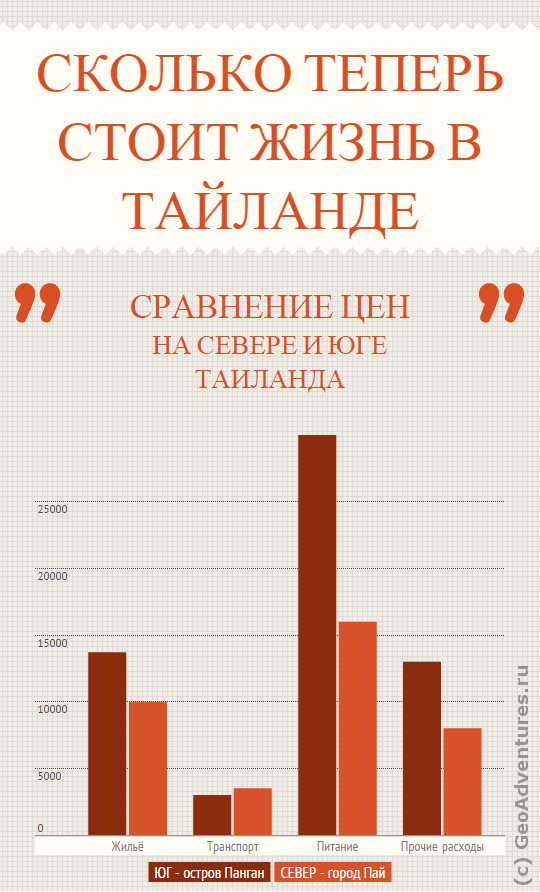
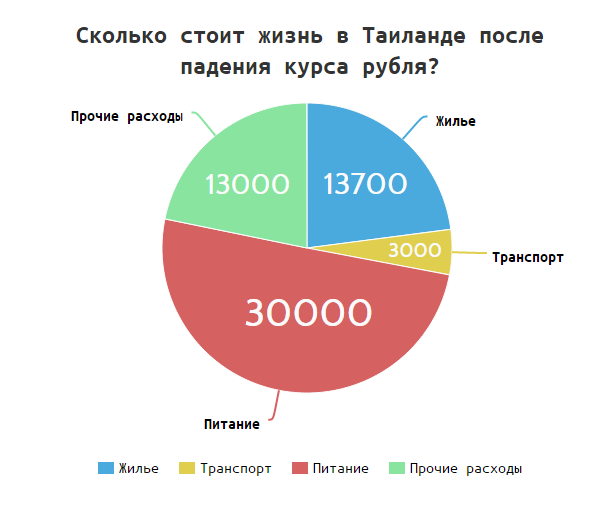
Comparison of prices for some products in the north and south of Thailand.
| Phangan | Pai | |
|---|---|---|
| Mango (baht per kg) | 120 | 60 |
| Young coconut (baht each) | 40 | 30 |
| Tomatoes (baht per kg) | 50 | 25 |
| Alcoholic cocktails | 120 | 90 |
Conclusions
The cost of living in the northern provinces of Thailand is 30-40% cheaper than living on the popular islands in the south of Thailand (59700 baht a month on the island of Phangan and 37500 baht in the town of Pai). Depending on your needs and overall standard of living, wintering in Thailand will cost about the same as living in Russia, or even less, despite the ruble's twofold drop.
Author of the article: Dmitry Ryazanov. All rights reserved. © GeoAdventures.ru