
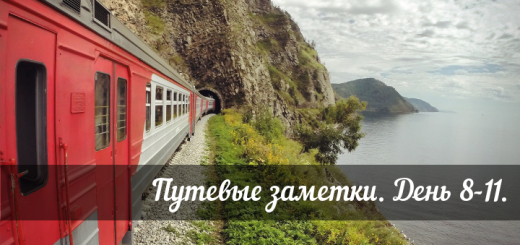
THE CIRCUM-BAIKAL RAILWAY
An early cool morning, Irkutsk. We head on foot to the railway station, where the Circum-Baikal express is already waiting for us. Crossing the bridge over the Angara, we risk being late for the train as we gaze at the amazingly beautiful sunrise over the city. Bright orange sun rays break through the concrete jungle and light up the smoke over the water in separate beams. It's very cold, only about 5 degrees above zero.
The Circum-Baikal Railway, in fact, is not laid around the whole of Lake Baikal, but only along a small part of it near Irkutsk (about 80 km). We have second-class tickets. Mostly foreigners ride in first class. At the junction station Slyudyanka, where a diesel locomotive is coupled to our electric locomotive, I got talking with a local railway worker who hinted to me that the conductors of the end carriages have the keys to the driver's cab. Anyway, I went straight to the driver, who turned out to be my namesake, and arranged for him to let us into the cab. Absolutely free of charge. So we swapped our second class in the third carriage for the driver's cab, in which we rode most of the way along the Circum-Baikal Railway. The trip took up the entire 8th day of the journey. The railway itself is unique. The views from the train window keep changing. Baikal is so varied. The presence of stops for swimming, excursions, lunches, and just free time pleasantly breaks up the trip and creates a sense of freedom.
A little lifehack about the Circum-Baikal Railway. Our tickets were checked only once during the whole trip. At the very end of the journey, when we were transferred from the train to a ferry that took us to the bus station, from where all the tourists were taken back to Irkutsk. So nobody paid attention to which class of the train you were riding in, or whether you'd boarded at one of the stops. So theoretically, if you decided to leave the express halfway and set up tents on the shore of Baikal, the next day you could probably board the next express without much trouble and continue your journey.
THE ROAD TO OLKHON ISLAND
The morning of the ninth day of the journey — the road from Irkutsk to Olkhon Island. I'm still riding in a car with the travel companions with whom we set off from Yaroslavl more than a week ago. You can cross to the island on a ferry absolutely free. Contrary to expectations, we found no queue for the ferry at all and were first on the list. Right after us a man pulled up on a fully-loaded touring motorcycle. He turned out to be a guy named Shalom from Israel. This Beast has been traveling by motorcycle for more than a year already. He began his current trip in March 2014 and in 6 months covered 45000 (forty-five thousand!) kilometers across all of Europe, Central Asia, Mongolia, and Russia. Later we met and became good friends with him, and now we're traveling together. Perhaps I'll write a separate note about Shalom a bit later.
An hour later we drive off the ferry onto Olkhon Island. This is where the most interesting part of the journey begins. I immediately noticed the looks in the local people's eyes as they watched us drive off the ferry in a passenger car. Along with us, several jeeps, UAZ "bukhankas" and GAZ "shishigas" crossed over. We had been warned that there are no roads on the island. But we weren't planning to leave the car on the mainland. I'm behind the wheel. First impressions: navigation doesn't work, there is a road, but it's hard to call it a road. There's a direction. It also turned out that I had imagined Olkhon's scale completely differently. From the ferry crossing to civilization — the village of Khuzhir — it's 35 kilometers….
For the first 7 kilometers or so we drove in second gear for about an hour, shaking over the bumps as if on a washboard, slowing down before every pothole. At that pace we would have needed at least another two hours on the road… I felt very sorry about "killing" someone else's car, but after an hour the feelings dulled. We'd sort of gotten used to the vibration and the bumps. And I sped up  after first driving right into the field. At 50 km/h there really do seem to be fewer bumps. I only just managed to dodge the boulders and the ground squirrels running across in front of the car. The squirrels, by the way, are completely invisible at speed. Until they stand up on their hind legs =)
We made it before dark, without incident. The whole road from Irkutsk took about 6 hours. It was a real challenge, first and foremost for the car. And it overcame it with dignity.
We settled in nicely, with a view of the famous Shamanka Rock. I ran around the village in search of smoked omul. The ninth day ended with a meal at sunset on the wild beach of Olkhon Island.
GETTING TO KNOW THE ISLAND
On this day we did a hiking trek of about 10 kilometers along the coast. The strongest impressions: everyone here knows everyone else, foreign tourists make up 50% of the total number of tourists, and the people are very distinctive. For example, after walking half a day to the village of Kharantsy, we looked for a chance to rest and grab a bite. Complete silence in the village. Most of the small number of houses are abandoned, and there are no people. Seeing a sign saying "Pozy" on one of the houses, we just went inside and asked where we could eat and how to get back out of here. Buryats live here. Pozy is a national Buryat dish. Similar to manti, only it's steamed. The hostess gladly started cooking them in front of us, telling us about her life on the island along the way. The beef is her own, and so are the eggs for the dough. The only things bought are flour and sugar. She told us about her children. How in winter they get to the only school on the island. The kindergarten, hospital, and library are also one of a kind — the only ones. There's no police of their own. If someone gets sick, they resort to the help of local shamans. In winter they don't get bored, because there's simply no time for it. Surviving in such conditions isn't easy. The village population is under 100 people. The pozy turned out to be quite edible. Even Yura, who is no fan of eating meat, appreciated them. We had to run around the village a bit more looking for a car that would take us back to Khuzhir. In the evening I arranged with the local guys to have a steam in a homemade banya built from the box body of a "GAZ-66" on the beach. The evening was a success. We swam until sunset.
As I already mentioned earlier, there are a lot of foreigners from all sorts of countries among the tourists. Here on Olkhon various creative people have gathered. Denis sits on the shore in the evenings and sings mantras to the guitar. Another guy puts on jaw-harp concerts. The Chinese climbed up onto a steep bank and sing some national songs in chorus to a flute. Some girl is painting buildings with patterns. A group on the shore sings shamanic chants and plays the bongo. I've already gathered a certain collection of audio and video recordings of local performers, and I'm planning to edit my videos using these tracks. The recording quality is so-so, but I think it'll be much more colorful this way.
We spent the whole of day 11 on a jeep trip to another part of the island in the company of two Frenchmen, two Germans, and an Israeli. Among the memorable things — the omul fish soup cooked by the driver over a campfire in the northernmost part of the island at Cape Khoboy, and the venomous pit viper (mamushi) that crawled up to us while we meditated on the cliff waiting for lunch. Over lunch we got talking with the Frenchmen. It turned out they had set off on a 1-year journey. And their route largely coincides with mine, including the dates. I tentatively agreed with them to travel through China together in mid-September. So the matter of travel companions is starting to sort itself out. In the evening I watched the sunset while meditating and listening to the mantras Denis sang on the shore to the guitar (I'll attach the audio recording to the post). I like it here. The energy!
P.S. Sometimes there's such an oppressive silence here that it makes you feel a bit uneasy. The birds don't sing in the forest. Only the seagulls occasionally squeak near the shore. The sound of an approaching car can be heard from about two kilometers away, even if it's driving somewhere far off beyond the mountain. And on Olkhon the moon hasn't been visible for three days now. I've never observed anything like this in my life. It's not that it can't be seen — there isn't even any light from it. So there you go.